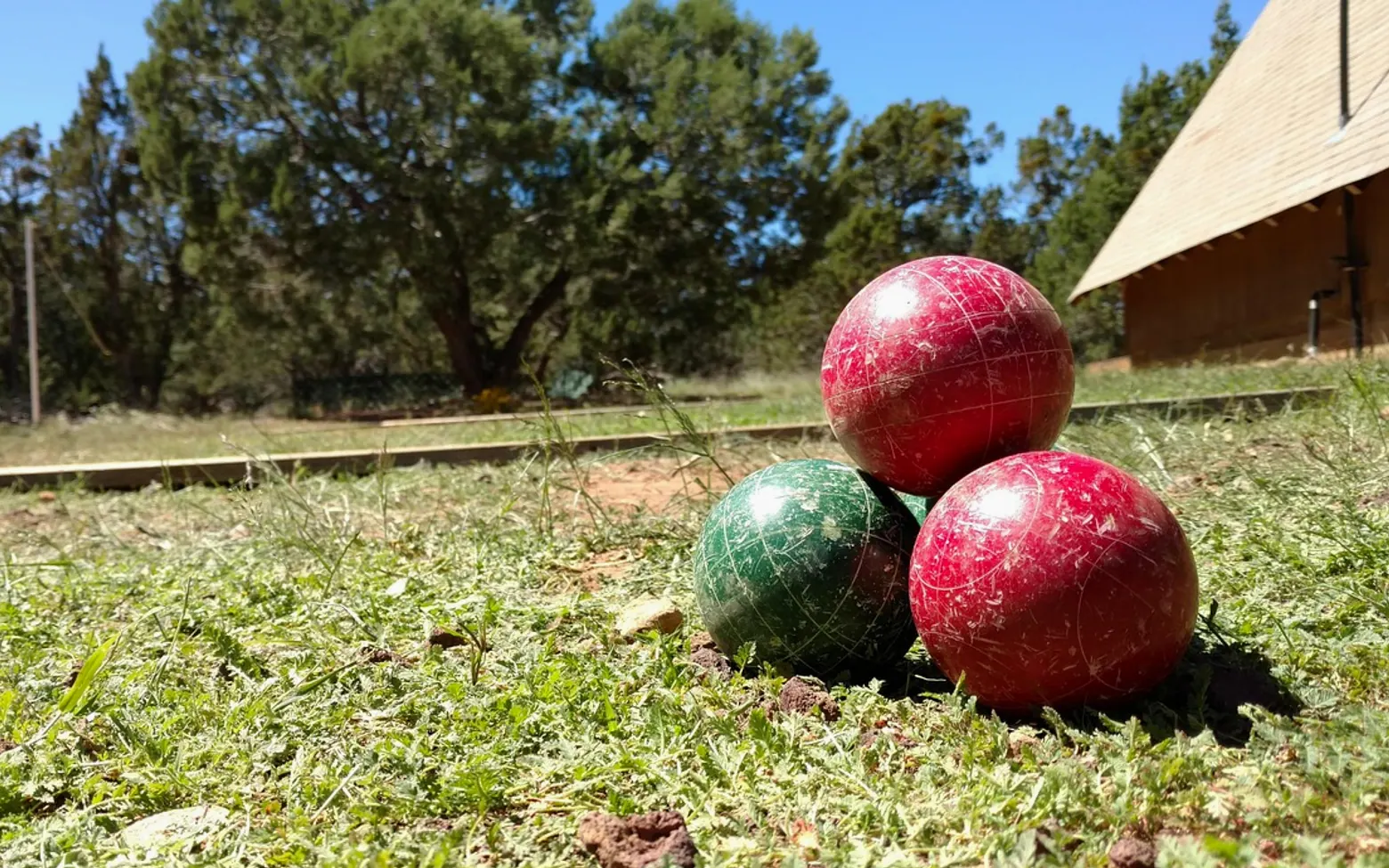
Bocce is played by two teams who take turns throwing large balls towards a small target ball, called the pallino. When all the balls have been thrown, the team with the ball closest to the pallino scores a point for each of its balls that sits closer than the other team's best one. The first team to reach an agreed total, often 12, wins.
That is the whole game in three sentences, which is exactly why it works so well at a garden gathering. Anyone can join after watching a single round, and the close calls keep even the most relaxed players leaning over the grass with a tape measure.
What you need
- A bocce set: eight large balls in two colours (four per team) and one small pallino.
- A playing area: a fairly flat lawn, a gravel path or a stretch of packed sand. Bumps and slopes are part of the backyard version.
- Something to mark a throwing line: a rope, a garden cane or a line scratched into gravel.
- A measuring tool: a tape measure or a piece of string for the close ones.
Teams can be one, two or four players. With two players a side, each person throws two balls; with four, each throws one.
Setting up a backyard court
Tournament courts are long, narrow and boxed in by boards, but a garden game needs only a clear strip of ground with a throwing line at one end. Choose the longest stretch available, away from windows, flowerbeds and the food table. If the lawn runs out at a fence or hedge, agree in advance whether a ball that hits it stays in play.
Many groups play "open" bocce, throwing from wherever the last frame ended and in any direction, which suits parks and uneven gardens. A fixed court with a line at each end feels closer to the formal game and is easier to keep fair.
Bocce rules, step by step
- Decide who starts. Toss a coin. The winning team chooses either the pallino or the colour of the balls.
- Throw the pallino. A player from the starting team throws it from behind the line. It must land past an agreed point, often the middle of the court, or the other team gets to throw it instead.
- First ball. The same team throws its first large ball, aiming to stop as close to the pallino as possible.
- The team further away throws next. The other team now throws, and keeps throwing until one of its balls is closer than the leading ball or it runs out of balls.
- Keep alternating by distance. Whichever team is not closest always throws next. When one team has used all four balls, the other throws its remaining balls.
- Score the frame. Once all eight balls are down, count the points and start a new frame from the other end.
Knocking balls around is allowed. A hard throw can push an opponent's ball away from the pallino, or even move the pallino itself, and the new positions count.
How scoring works
Only one team scores in each frame. Find the opponent's ball that is nearest the pallino; the scoring team gets one point for every ball of its own that lies closer than that one. So a frame can be worth anything from one to four points.
| Situation at the end of a frame | Points |
|---|---|
| Red has the closest ball, then blue | Red 1 |
| Red has the three closest balls, then blue | Red 3 |
| All four of blue's balls beat red's best ball | Blue 4 |
| The closest red and blue balls are exactly level | No points; replay or move on, as agreed |
The team that scored throws the pallino in the next frame. Games usually run to 12 points, though plenty of groups play to 13, 15 or 16. Settle the target before the first throw rather than halfway through.
Three throws worth knowing
The roll
Often called punto, this is the basic shot: an underhand throw that lands early and rolls the rest of the way. Swing the arm like a pendulum, release low and follow through towards the target. Most points come from this throw.
The lob
Sometimes called volo, the ball is thrown higher so it drops close to the pallino and stops quickly. It is useful when the path is blocked by other balls, or on bumpy grass where a roll wanders.
The hit
Known as raffa, this is a firm throw meant to knock an opponent's ball out of position. It is satisfying when it works and costly when it misses, so save it for frames where the other side is clearly ahead.
Small tips that make a difference
- Walk to the far end and look at the ground before your first throw; slopes are easier to read from the side.
- On a two-player team, let the steadier roller throw first and keep the stronger thrower for hits.
- Do not measure by eye when it matters. String or a tape settles arguments quickly.
- Pick up balls only once the frame has been scored.
Bocce and other garden games
Bocce belongs to the same family as boules and lawn bowls, and it sits comfortably beside the other games in our list of backyard games for adults. Groups who like the steady rhythm of throwing and scoring usually take to cornhole and its scoring rules as well, and a bocce match makes a calm station between the races at a field day with team challenges. With a set in the shed and a stretch of grass, an ordinary Sunday afternoon has a plan.