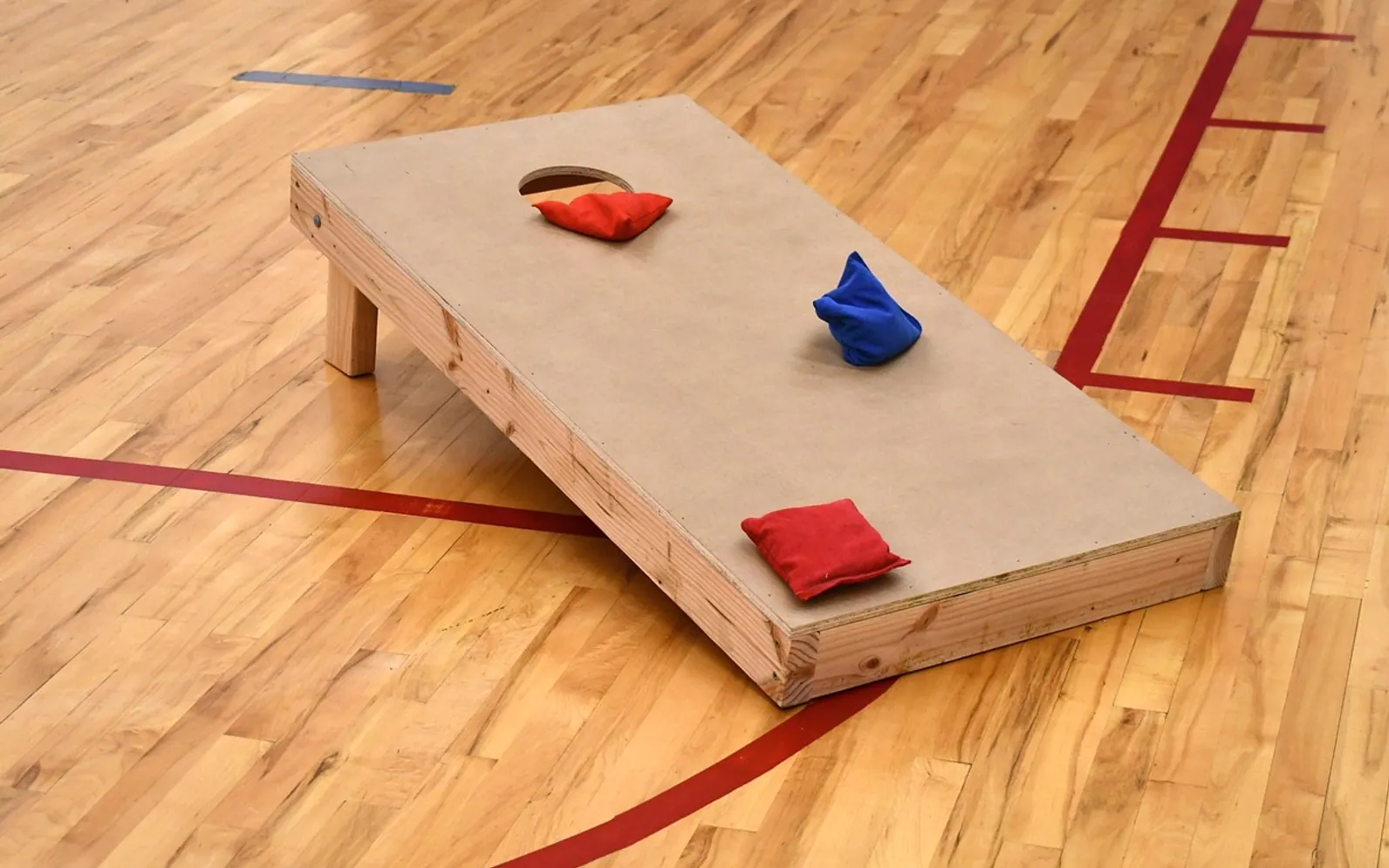
Cornhole is a bag-toss game played between two slanted boards. Players take turns pitching fabric bags at the far board, earning three points for a bag that drops through the hole and one point for a bag that stays on the surface, and the first side to reach 21 wins. That simple idea is why the game turns up at tailgates, weddings and garden barbecues alike. Below you will find the setup, the standard rules, how scoring works and how to throw a bag that lands where you meant it to.
What you need
- Two boards. A regulation board has a playing surface two feet wide and four feet long, with a six-inch hole near the top. The back edge stands roughly a foot off the ground, while the front sits only a few inches up.
- Eight bags. Four in one colour and four in another. Standard bags are six inches square and filled with feed corn or plastic pellets; pellet bags cope better with damp grass.
- Level ground. A lawn is fine, though a patio or flat gravel stops the boards from rocking.
- Something to keep score with. A notepad, chalk or a note on a phone does the job.
Setting up the court
Place the boards facing each other with the holes at the far ends. Tournament rules put the front edges 27 feet apart. That distance feels long for children and first-timers, so in a garden it is perfectly reasonable to bring the boards closer, as long as everyone agrees before the first throw. Leave a few feet of clear space on either side of each board, because that strip, often called the pitcher's box, is where throwers stand.
The front edge of each board doubles as the foul line. Players may step right up to it, but a foot over the line cancels that throw.
The basic rules
Singles and doubles
In singles, both players stand at the same board, one on each side, and pitch all their bags at the opposite board before walking down to count and throw back. In doubles, partners split up so that each end has one player from each team. Nobody walks between rounds; the action simply swings from one end to the other.
Taking turns
Players alternate throws until all eight bags are down. That completes one round, also called an inning or a frame. A coin toss decides who opens the game, and after that the side that scored in the previous round throws first.
Bags that do not count
- A bag that hits the ground first and then bounces onto the board is removed.
- A bag hanging off the edge while touching the ground scores nothing.
- A bag thrown with a foot beyond the foul line is taken off.
- A bag knocked into the hole by another bag still earns three points for its owner, even if an opponent's throw pushed it in.
How to score in cornhole
Cornhole uses cancellation scoring. Each side adds up its points for the round, and only the difference goes on the scoreboard.
| Where the bag ends up | Points | What players call it |
|---|---|---|
| Through the hole | 3 | A cornhole |
| Resting on the board | 1 | A woody or board bag |
| On the ground or off the board | 0 | A miss |
Here is cancellation in action. Blue sinks two bags and leaves one on the board for seven points. Red sinks one and leaves two on the board for five. Seven minus five is two, so Blue adds two and Red adds nothing. When both sides finish a round level, nobody scores at all.
How to keep score in cornhole without arguments
Count only after all eight bags have landed, since late throws often push earlier bags in or knock them off. Call out both totals aloud before anything is written down, and keep one running tally that everyone can see. Under the usual rules, the first side to reach or pass 21 at the end of a round wins. Some garden groups prefer a bust rule, where overshooting 21 sends a team back to a lower agreed number. It adds drama, but settle it before play begins.
How to throw a cornhole bag
A good throw is smooth rather than strong. Most beginners overpower the bag and watch it slide straight off the back.
- Hold it flat. Rest the bag across your fingers with the thumb on top, folded or open as you prefer.
- Step with the opposite foot. Right-handed throwers usually step forward on the left foot, much like bowling.
- Swing underarm. Keep the arm fairly straight and let the movement come from the shoulder.
- Release near waist height. Aim for a gentle arc that peaks about halfway between the boards.
- Add a little spin. A flat, rotating bag, nicknamed a pancake, lands softly and grips the board instead of tumbling.
- Follow through. Finish with your hand pointing at the spot you want the bag to reach.
Shots worth learning once the basics click
- The slide: land the bag short and let it glide up into the hole.
- The airmail: a higher arc that drops straight through without touching the surface, handy when bags crowd the front.
- The blocker: a bag left short on purpose to guard the hole from an opponent's slide.
- The push: a firmer throw that nudges one of your own board bags into the hole.
Common beginner mistakes
- Throwing hard on a slick board. New or freshly varnished surfaces are fast, so soften the release.
- Changing technique every turn. Keep one grip and one release, and adjust only the distance.
- Skipping the opposite-foot step, which tends to pull throws to one side.
- Setting boards on soft, bumpy grass, where bags bounce unpredictably.
Quick questions
How many points do you need to win at cornhole?
Twenty-one under the standard rules. Casual groups sometimes play to 11 for a quicker match.
Can children play on full-size boards?
Yes. Move the boards closer, let younger players throw from in front of the foul line and keep the scoring unchanged.
What pairs well with cornhole at a party?
Our round-up of backyard games for adults has plenty to fill the rest of the lawn. For a school-style afternoon of races and team events, the guide to field day games slots a cornhole station straight into the rotation, and if the boards are part of a bigger celebration, these garden party decoration ideas help set the scene.